A commercial invoice is different from many other invoices because it is an invoice that is used specifically to ship goods abroad.
Not all commercial/shipping invoices will be in the same style, as many companies like to produce them in-house. Probably the most significant thing that differentiates them from other invoices is that it must contain specific pieces of information.
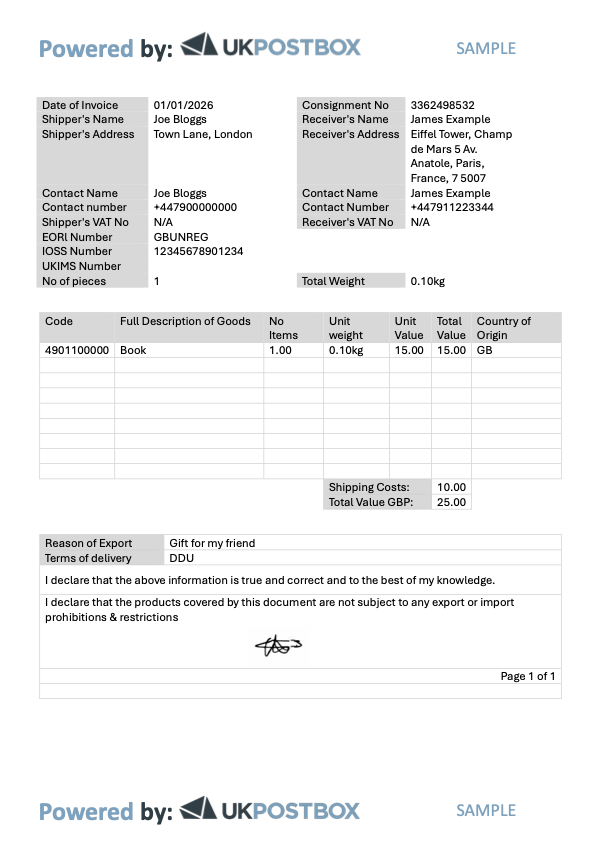
UK Postbox provides a facility for customers to create their commercial invoices from their forwarding batches. The commercial invoice is generated by UK Postbox but it's your responsibility as the forwarder to ensure that your information is correct.
If you are an E-retailer or Dropshipper commercial invoices will be a part of your everyday shipping. Ever wondered why the Commercial Invoices generated in UK Postbox are structured in the way they are? This blog provides all of the information.
The Musts and Usage of a Commercial Invoice
Any commercial invoice, no matter how it is formatted, must contain the names of both parties involved in the shipping arrangement, i.e. the name of the company or individual that is exporting the goods and the name and details of the intended recipient. In addition to the names of the parties involved in a shipping transaction, the invoice also needs to specify the nature of the goods that are being shipped, including the country of their manufacture / origin.
The invoice is used in international trade, which refers to the import and export of goods as they are made across international barriers. Although the main difference between trading in your own country and trading across borders is not dramatically different, the practice of foreign trade is a lot more expensive because of the tariffs and time costs that are involved.
Core Components of a Commercial Invoice Template
A well‑prepared commercial invoice should include:
Exporter and Importer Details: Names, addresses, and contact info.
Description of the Goods: What the items are, quantities, weight or volume, and their HS (Harmonised System) codes.
Value of Goods: Price per unit, total price, currency used.
Cost of Postage: The total cost of transporting the goods, detailing shipping fees and insurance.
Country of Origin: Where each item was manufactured.
Delivery Terms: Incoterms like FOB, CIF, or DDP – clarifying who pays for what (shipping, insurance, import duties).
Signature and Declaration: Often signed by an authorised representative to affirm the data is correct.
About HS (Harmonised System) Codes
All goods that are shipped abroad must use what are known as harmonised system codes, which need to be stipulated on the commercial invoice.
These are also referred to as:
Harmony Codes
Commodity Codes
HTS Codes (Harmonized Tariff Schedule)
Tariff Codes / Customs Tariff
A harmonised system consists of a commodity or product description and also a coding system.
The harmonised system is an international standard means of classifying products that are shipped from one country to another. e.g. 6109100010 for cotton t-shirts and 8517120000 for smartphones. Harmony codes must always be 8-10 digits.
The World Customs Organisation or WCO – an intergovernmental organisation - developed and maintains the system of names and numbers that are used to classify products both of the parties involved in the shipping process must use the required digits on the invoice. In addition to the above a commercial invoice needs to have a statement from the exporter stating that the invoice is correct and the document must be signed.
Creating a commercial invoice in UK Postbox
UK Postbox provides a facility for customers to create their commercial invoices as we auto-generate them for you from the information that you provide when creating a forwarding batch.
Completing a forwarding batch is easy:
Step 1: Batch details - Specify whether your batch only contains documents
Step 2: Items details - Please ensure you tell us about everything your letters/parcels contain. It's important to provide complete and exact product descriptions and the declaration should be in units rather than line total. If the value of any individual item in your batch is above £5000.00, please contact our Mailroom Forwarding team.
Step 3: Contents Declaration - In the interest of safety to both UK Postbox and the postal and courier networks, you must correctly declare the contents of your items. Please tell us what your package(s) contains. This information will also be used to ensure compliance with national, and international, transport regulations in relation to prohibited and dangerous goods.
Step 4: Notes - If you'd like to include any notes to the mailroom, please add them to the notes field.
Step 5: Documents - You can provide us with documents that will help us ship your batch, such as a waybill, printed documents to be sent with shipment, delivery note/order confirmation or your own commercial invoice.
Step 6: Legal - Confirm that you understand and agree with the legal statements
The commercial invoice is generated by UK Postbox but it's your responsibility as the forwarder to ensure that your information is correct.
Make sure your commercial invoice includes all required fields (HS codes, origin, Incoterms, VAT terms).
If you’re shipping to the EU (especially via France), update your template to reflect who is responsible for VAT and duties.
Consult a Customs Expert
Speak with a freight forwarder or customs broker who understands the upcoming Regime 42 changes.
Digitise Your Processes
Move away from paper invoices or manually typed forms.
Use software or cloud-based platforms that support structured data (for customs declarations) and integrate with your shipping systems.
Train Your Team
Make sure anyone involved in shipping, billing, or compliance understands the changes.
It’s not just the logistics team. Your finance and sales staff will also benefit from clarity.
Monitor Regulatory Updates
Stay informed on both UK and EU regulatory changes (customs, VAT, trade agreements).
Use reputable sources (e.g., HMRC, trade bodies, logistics partners) to keep ahead.
Why a Commercial Invoice Is More Important Than Ever in 2026
Here’s where things are especially relevant in 2026. Several regulatory and trade changes are on the horizon, and many of them affect how you might use or prepare commercial invoices.
1. Major VAT Changes in the EU
From January 2026, France has ended the use of Regime 42 VAT simplifications for non-EU businesses. This means UK exporters can no longer rely on previous structures to defer import VAT when shipping via France. Instead, businesses must either register for French VAT or adjust their shipping terms. As a result, commercial invoices must clearly show values, responsibilities, and Incoterms, as customs authorities are placing greater scrutiny on who is liable for VAT and duties.
2. Stricter Rules on Low-Value Shipments
The EU is moving to remove the €150 duty-freethreshold for low-value imports and introduce additional per-parcel charges. This has significant implications for e-commerce and high-volume, low-cost shipments. Commercial invoices now play a critical role in declaring accurate values, as under-declaration is far more likely to be flagged and penalised.
3. Global Shift Towards Protectionism
Other markets are following a similar trend. The United States has already tighten edits rules on low-value imports, increasing duties and compliance requirements for UK exporters. At the same time, the UK is reviewing its own £135 threshold, suggesting that further changes may be ahead. These shifts make it more important than ever that commercial invoices are complete and accurate forevery shipment.
4. Increasing Digitalisation of Customs
Customs systems are becoming more automated, with authorities relying onelectronic data and risk-based checks. This means commercial invoices must align exactly with other shipping documents and declarations. Even small inconsistencies can result in delays, inspections, or additional costs
5. Greater Compliance and Enforcement
Across the board, enforcement is tightening. Customs authorities are placingmore emphasis on correct classification, valuation, and origin of goods. A well-prepared commercial invoice is now central to demonstrating compliance andavoiding disruptions in the supply chain.
To benefit from the UK Postbox commercial invoice generator, why not sign up to an account to start managing your parcel shipping wherever you are in the world. Stay compliant, stay professional, and stay ahead.
As Chief Operating Officer at UK Postbox, what Liam doesn’t know about UK Postbox isn’t worth knowing. Liam is a driving force on the team, helping guide UK Postbox into the future. His keen eye for detail means he’s always on the ball when it comes to UK Postbox news, updates and new products, and his blog posts will keep you updated on all of it!
Increased shipping destinations are beginning to implement Exporting Surcharges which are payable by the recipients on delivery when items are shipped DDU (Delivery Duty Unpaid).
We’ve outlined the specific Companies House administrative filing responsibilities of company directors, including confirmation statements and annual accounts.
An outline of terms and abbreviations across General Shipping, Customs & Documentation and Carriers & Logistics. We also note key terms for UK Postbox services.
If you ship to the United States, there’s an important change to duty-free thresholds that could affect your day-to-day mailing and shipping operations.
As covered in our Companies House Reforms blog, director identity verification is to become mandatory on 18th November 2025. What does this mean for you?
Worried about US trade tariffs affecting your business? Discover how UK Postbox can help you reduce or avoid import duties with smart shipping solutions, including fulfilment, dropshipping, and parcel forwarding.
The IOSS system aims to streamline the way VAT is paid on goods being sold to the EU. Learn what this is, why it’s been introduced & how it’ll affect you.